THE BEARD QUESTION
The Key to Hypnotism – Walter B Gibson
I got a mysterious package in the post some weeks back now… Out tumbled two magician-penned vintage stage hypnotism books: this one, The Key to Hypnotism, by Walter B Gibson, published in New York, USA, in 1956; plus a pamphlet filled with 1930s vaudevillian secrets, which Kev wrote about here.
They were sent to me by an acquaintance at The Magic Circle, with sincere thanks. Magicians have a unique perspective on hypnotism, and professional American magician and author Walter Brown Gibson (1897-1985) was something of a ‘wizard-behind-the-curtain’, ghostwriting tricks and methods for famous magician friends including Harry Houdini and Howard Thurston. He was a member of the American Society of Psychical Research, and his supernatural and supernormal inclinations clearly inform this book’s conception and contents.
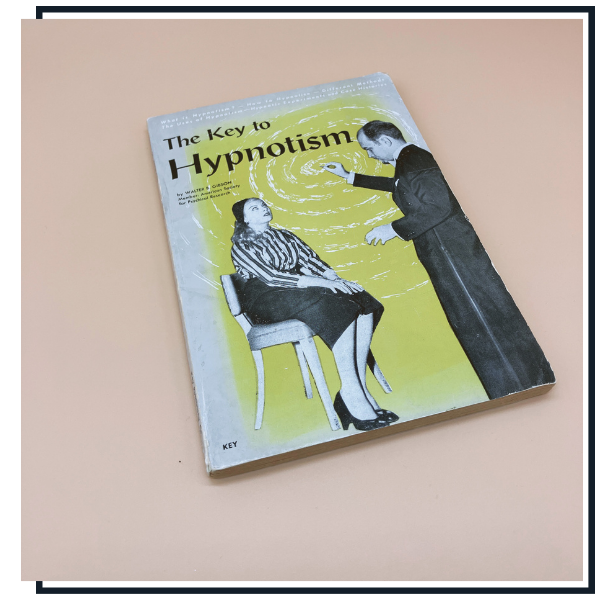
First up, what a striking cover. A dapper magician-hypnotist fascinates an amenable lady subject with a shiny button or coin, her mind caught in his hypnotic spiral. I later learned that our coat-tailed photographic model is James ‘The Amazing’ Randi, Canadian-American stage magician, author, and skeptic, whom Kev once met during his Head Hacking days. Gibson makes pains to explain the precision and flair in the action shots of Randi and his subjects. For instance, a photo of Randi hypnotising a besuited male subject using an “original Braid method” of gazing at the operator’s two extended fingers has the “added feature of head pressure”. Randi, in Svengali costume, is harnessing then-recent ‘Scientific Hypnotism’ combined with the showmanship and authority of French/European mesmeric/magnetic hand and bodily commands. ‘The Hypnotist’ is a familiar, gendered, prestige role that this American readership was au fait with and aspired to, with much of the book exploring ‘Eastern’ and ‘Oriental’ flourishes, secrets, rumours, misinformation and lies to add to their own repertoires and grimoires.
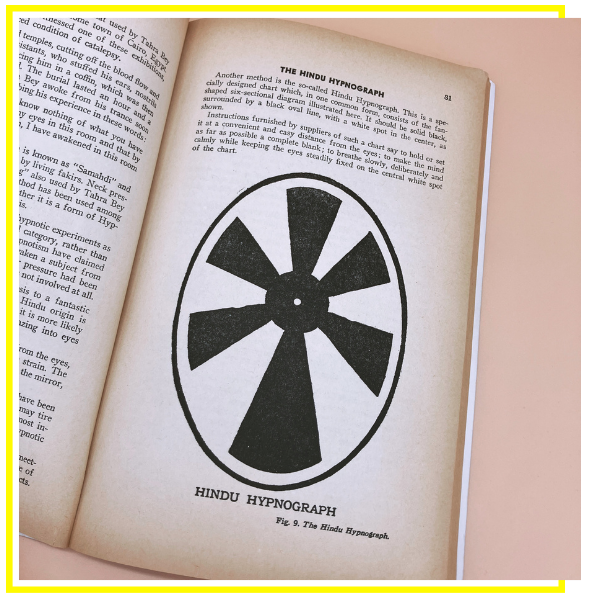
The foreword states that, “The constantly growing interest in Hypnotism has demanded a new and popular treatment of the subject.” Gibson begins by likening hypnosis to sleep. It’s not. But that perspective serves the occult-curious showman perfectly because: If you consider it, you’ll find, more and more, that it is just like sleep, sitting here, relaxing, listening to the sound of my voice, entering into hypnosis, that’s right sleep, sleep, sleeeeeep… Or just the – sometimes silent glare – command to: SLEEP! ‘Hypnotism’ is a tool or technique that simply exists, and here is how the modern magician can harness it. The book’s inclusion of an ‘Aladdin’s cave’ of mystic secrets, such as the ‘Hindu Hypnograph’, pictured, suggest some of the more fantastical feats of hypnotism *could* be real. But he’s also packaging it for a professional readership – Randi is an aspirational exemplar, serving vaudevillian theatrics with real medical/psychological convincers. This stance makes for a jarring, self-selective, self-serving, suspicious journey through the subject – in sum: Mesmer, Braid, and Co flung open the doors to hypno-dream-magick Hypnosis, as practised by ancient Egyptians and other arcane cultures; then there’s a bit of Freud before it becomes very much about dreams, fantasies, woo-woo – ie, ‘hypnotic regression’ is just a practical-magick tip to turn yourself into an alarm clock.
Not, um… hypnotism.
I don’t revel in writing about the macabre, but Gibson’s real starting point is the ‘self-hypnosis’ associated with apparent endurance and trace-y ‘death-rebirth’ stunts of ‘fakirs’. Ranging from ‘real’ ‘holy men’ of, eg, Egypt and India, and Colonialism’s Got Talent entertainment finds, to charlatans and opportunists, Gibson gives respectful consideration to the mental and physical ‘maybes’ of achieving the death-defying magic stunts, and ‘miracles’, that were causing public sensations (according to the press, etc), with ‘hypnotism’ agreed as a unifying explanation. Of course, Gibson knew the practical secrets of, say, Houdini’s ‘Chinese Water Torture Cell’ or ‘Living Burial’, but the mindset of endurance and extremes became currency among thoughtful, articulate magicians and laypersons. In the book, we meet new ‘peers’: Rahman Bey, “an Egyptian fakir, or wonder worker who visited America”; Tahra Bey, “another Egyptian mystic who had previously toured Europe, performing near-miracles which astonished huge audiences”; and Hamid Bey, who “doubled Houdini’s record with a three-hour burial in Englewood, New Jersey.” This trio of Beys is not to be confused with the “famous Arabian Fakir” Tara Bey, sacred human pincushion of Paris. The abundance of Beys is given ‘fair’ supernatural, supernormal, and psychological consideration for the time, though I sense Gibson may be sub-book consoling the ‘long-sleep artists’ whose role in hypnotic history remains little explored.
“What really confused the issue for Tahra Bey and other Egyptian fakirs were the numerous imitators who sprang up. Many of those were fakers; not fakirs. But most of them were able to assume an autohypnotic state; at least to some degree. The reason was odd, indeed.
“For years, old time professional hypnotists had carried special stooges, or “horses,” as they were known in the trade. These were not just “plants” who could be picked up in any town. They were persons actually susceptible to Hypnotism, who could be “put under” so effectively that they could submit to torture tests, night after night.
“Old style hypnotic acts had gone out of vogue at the time the Beys came suddenly into fame. So the former “horses” – and there were a lot of them around! – took over as hypnotists in their own right. They grew beards, adopted fanciful names such as Punjab, and appeared on the stage as genuine Oriental mystics. Naturally, they used some tricks that could be exposed.”
Cultural insensitivities aside, how many proud and true (self-)hypnotists of The Long-Sleep were lost among this mess of understudies, vagabonds, mystics, dreamers – imposters?! The ‘window stunt’, where a ‘sleeping beauty’ is put in deep trance and left laying overnight in a shop window near to the theatre for passersby to inspect, pre-show, was a staple of the hypnotist’s repertoire. Gibson captures the sudden trend for high-stakes death-rebirth capers, with ‘Hypnosis’ the literal key to drawing crowds. Figures such as Aleister Crowley and Alexander Cannon were presumably turning every fourth Monday night down The Magic Circle into scenes from Young Sherlock, invoking obscure Deities and every aristo, royal, and journo in their Rolodex. Putting oneself under grandiose and ghoulish ‘psychic stressors’ was already of questionable taste and safety, with ‘sanity’ often subject to social status; as such, representatives from psychical and occult societies and committees, as per Gibson’s credentials, often played arbiters. Perhaps white male ‘shut-eyes’ of Europe and America being shown up by textbook stage tricks from places like India required a magician of Gibson’s repute to expose confederates, and set a new shared reality, etiquette and motif – with Randi as an archetype and lone operator. For me, the book is communicating that long-sleep stunts have peaked and that the spectacle of seeing an entranced person laying prone for some hours using ye olde magic of ‘Hypnosis’ would now be met with public derision without a coffin, a tonne of sand, a resurrected Bey, and a press sensation.
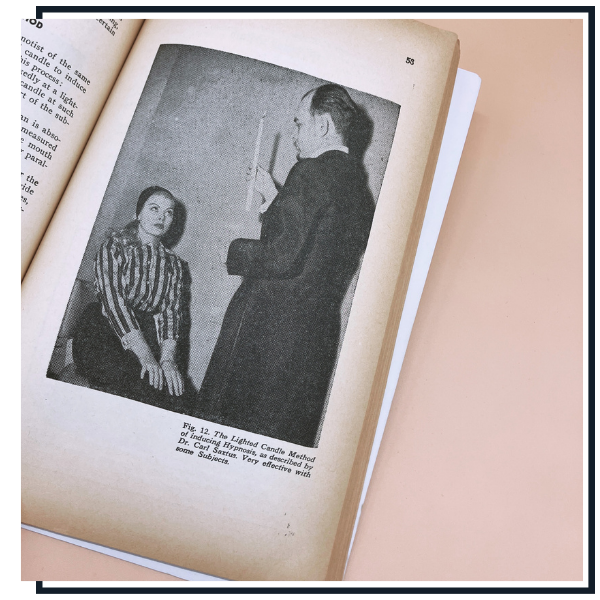
Much of the book takes the reader through the Braidian ‘Scientific Hypnosis’ that Gibson and his peers subscribed to, as demonstrated by Randi in generous photography. Dr Moll, Liebeault, Richer, “the Nancy method”, George de Dubor, Dr Cook… There’s plenty of name-dropping and a reassuring sense that any magician can perform this package of hypnosis, on or off stage, to credible, impressive effect.
The book ends with a surprise mention of Donato! Donato is a recurring mystery of hypnotism’s past; here’s his most recent appearance on this blog. In describing hypnotic imitation acts, Gibson states that: “Like Charcot’s gong, the glaring eyes of Donato were sufficient to induce almost the instant fascination in a subject”. What was known as “Donatism” is, says Gibson, a fascination method akin to that detailed by Moll. “By gestures, which in turn may be coupled with verbal suggestions, the subject can be made to kneel, raise his arm, or remain in fixed position.”
“Donato, according to contemporary accounts, was a forceful, bearded, bushy-haired individual with an actually frightening countenance. This must have had a powerful effect upon highly susceptible subjects, which was a good reason for him to specialize in his pet method.”
Hmm… Precisely whom did you base Svengali upon, Mr du Maurier..?! That a forgotten ‘Second Coming’ legend like Donato is aligned with apparent Scientific Hypnosis progress is just the spin you’d expect from a member of Houdini’s inner circle. Modern hypnotism gave magicians new license to operate – in the age of Hollywood movies bringing big stunts to the masses, Gibson’s book positions him as a new kind of American psychical diplomat as well as practical expert on the subject.