SO NEAR BUT YET SO FAR
Dunninger’s Master Methods of Hypnotism – David J Lustig (La Vellma)
Recently I read and wrote about another of Lustig’s books/pamphlets, You, Too, Can Be A Hypnotist… (which continues to have the longest title of a book or pamphlet known to man, and isn’t restated here as my contribution to help save some bytes for the Internet), and that turned out to be only about how to fake a stage hypnotism act. Interesting and insightful, nonetheless, but much more about how to magically present hypnotic powers (and how to dupe the audience!) than anything actually about hypnosis. It did, however, recommend this current book for details on the science, so here we are.
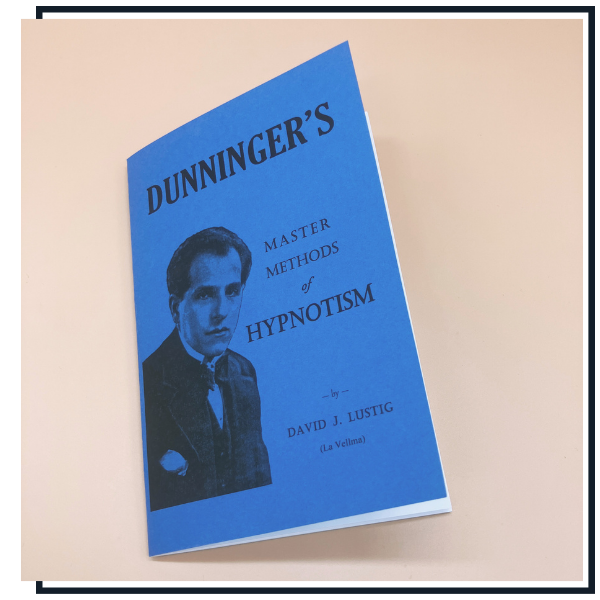
The science as per 1923, when the book was originally published, wasn’t great. Lustig is bold in his writing and asserts that he’s previously written a number of book on the science of hypnosis. He is sure he knows his stuff, which would be no different to most of the books we write about here, but this book contains a conceptual twist. He isn’t supposedly writing about the science here (although obviously he cannot help himself), he is supposed to be writing about Dunninger’s methods of hypnotism; his “master methods” of course, because Joseph “The Amazing” Dunninger (1892-1975) was then the Derren Brown of his day.
To be clear, Dunninger was a magician, and he did it all. I have a book celebrating him and it includes the details of making a horse disappear, as well as how to be buried alive. But he was known mostly, if my scant magical history knowledge serves me well, as a mentalist, presenting feats of telepathy and mind reading. Hypnotism appears to be a natural bedfellow, and this book not only suggests that Dunninger performed some hypnosis, but claims to describe his methods.
If you know anything about magic (and this applies absolutely to Derren Brown), then you’ll know that what a magician tells you they are doing, and what they are actually doing, are very often very different things. So remarkably different that I like to think that after the deflation that comes from understanding how a trick was actually done (if a naughty magician has broken the secret code and revealed something), that there is an astonishing rabbit hole to go down that starts with, “Wait, you were doing all that while I was staring right at you!?”, and ends in financial troubles, a vast amount of storage for tricks that you’ll never learn, and an unhealthy obsession with how you hold things.
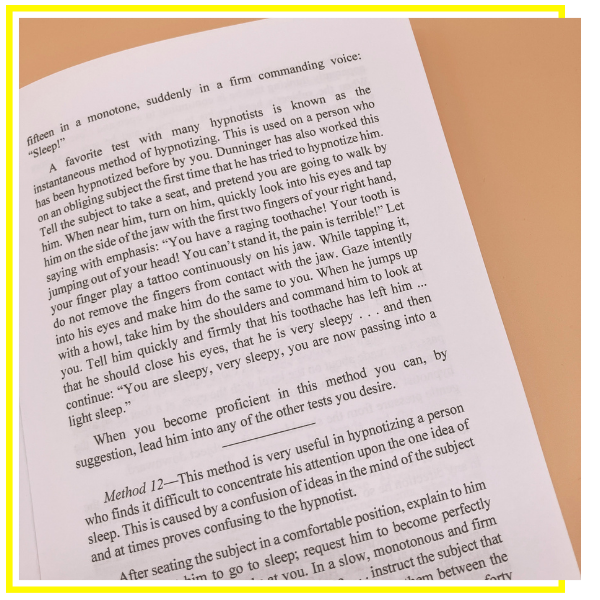
So what we have here is one person – Lustig, a hypnotist who thinks they understand the mesmerism/Braidism depiction of hypnosis – writing about the methods of another person; Dunninger, a magician who lies for a living. See the problem? The outcome is fascinating because it has to accommodate Lustig’s knowledge, while also presenting Dunninger’s perspective, which appears orthogonal to his own! If he’d just stuck to the methods then he could have avoided theory, but instead of expanding the routines with more detail and minutiae, he instead wrote at lengths about what he thought he knew.
Among pages and pages that present hypnosis as a state, into which someone must be induced in order to respond to suggestions, interesting snippets of (what I assume to be) Dunninger appear. The book stated, “As the hypnotist has no special power, it would be impossible for him under any circumstances to gain either temporary or permanent control over his subject.” And if we want a more direct metaphor for phenomenological control, the preceding paragraph stated, “The person hypnotized… has really done more himself or herself to induce the condition than the hypnotist’s efforts.”
So far, so non-committal; this could just be semantics. Lustig describes Dunninger’s 12 favourite methods of inducing hypnosis; these are all the usual combinations of position (standing, sitting, laying down), focus (gaze, shiny object, spot on wall), and outcome (sleep, eyes cannot open). As always, the common parts are where the magic happens: the settings, the confidence, the suggestions for sleep. In Dunninger’s case, he brings all the situational demands that Derren Brown does; remember, if you expect to be hypnotised, then you’re much more likely to be. But, of course, Lustig doesn’t focus on these commonalities because, to him it seems, all the passes and staring Are Absolutely Necessary.
But among the methods were two things of real note. The first is more a curiosity of hypnosis history that I hadn’t come across before. It involves a small-gauge, wire mesh screen encased in a wooden square frame. It is held so that, as the participant focuses on the hypnotist’s eyes through the screen, the hypnotist can subtly move the screen to mess with their focus, potentially making their eyes tired. Fun note: I always, since I was a kid, assumed “Your eyes are getting sleepy” and “Your eyes are getting tired” were suggestions to encourage eye closure; I now wonder if these are pacing statements of a pace-and-lead combo where the lead is, “You are sleepy, very sleepy, you are now passing into a light sleep”. In other words, because almost all of these methods engineer a situation where the eyes will get tired, telling them their eyes are actually getting tired is just a verifiable statement of fact. If they have suitable expectancies, they might also take the following statement, the lead “Sleep”, as also a fact, and therefore a direct suggestion to respond to. So maybe there you go; maybe pacing and leading was around in the 1920s and maybe also all the way back to Braid!
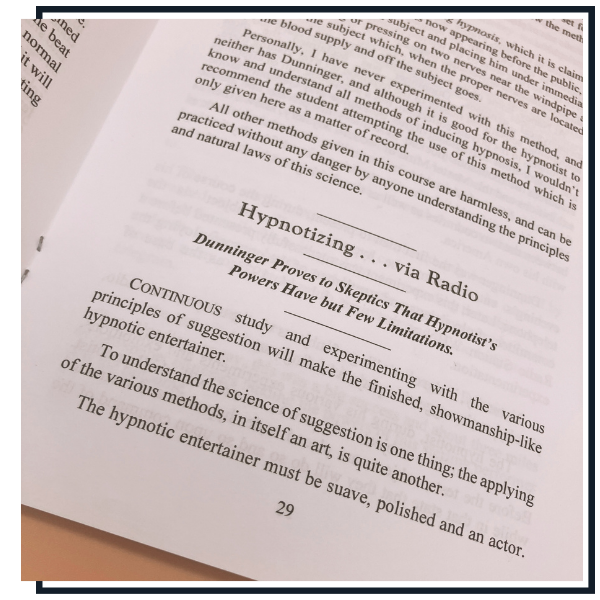
But, hey, I don’t think Dunninger believed any of that. I think Dunninger believed it was all suggestion and theatrics. A case in point is placed after method 11 and is introduced as, “A favourite test with many hypnotists is known as the instantaneous method of hypnotizing.” Lustig states this is usually done with a participant that has previously been hypnotised (at Head Hacking we erroneously called this ‘permanosis’), but that Dunninger has done this with participants he has not previously hypnotised. It might be worth noting that it doesn’t specify that the participants hadn’t been hypnotised by anyone else… But, regardless, this is teeing up a suggestion that will be given cold. No induction, no state, no passes, no tired eyes, no focus, no shiny objects, and no sleep. I was excited! If the suggestion was good, then this sounded a lot more like a non-state approach to hypnosis; not dissimilar to some of Derren’s early routines on Mind Control, and of course entirely fitting with the frame of cold control and phenomenological control.
And the suggestion was a banger!
“Tell the subject to take a seat, and pretend you are going to walk by him. When near him, turn on him, quickly look into his eyes and tap him on the side of the jaw with the first two fingers of your right hand, saying with emphasis: “You have a raging toothache! Your tooth is jumping out of your head! You can’t stand it, the pain is terrible!” Let your finger play a tattoo continuously on his jaw. While tapping it, do not remove the fingers from contact with the jaw.”
And where did I first see this routine, specifically without an induction? On Derren Brown’s Mind Control! An insightful reader would realise that if the toothache suggestion was possible without an induction/state/theatrics, then maybe everything is possible in the same way, making the induction and state just theatrics in themselves? They might conclude that the whole routine building up to the suggestion is just theatrics through and through! They could then reread the book, separating the theatrics from the suggestions as they went, and realise that, while Lustig knew nothing, that Dunninger’s statements about hypnosis (such as that nobody can be hypnotised against their will, that they stay conscious while hypnotised, etc) were the actual truth and not just marketing/arse-covering to both calm volunteers while also avoiding their potential later legal challenges. Who knows? Maybe it was the book that got Derren started?!
Another point, and one that is seen throughout the literature of the day, is, “The successful hypnotist must have an abundance of self-confidence to enable him to instill (sic) confidence of his powers in his subjects.” I don’t disagree, as a less-than-confident person rarely convinces anyone they are a hypnotist, but this is at odds with Lustig’s contemporary understanding of hypnosis, which suggests eye-closure and “entering a state of hypnosis” are unrelated to the apparent confidence of the hypnotist. Puységur realised the form of the crisis (loud and violent or still and silent) was related to the way the magnetism was done; Braid realised that magnetism was unrelated and that the sleep was metaphorical (thanks Wikipedia!); and Bernheim realised that the state was unnecessary but stopped short of stating it was the result of suggestion. There is a thread running through this history that suggests that it is all suggestion and the rest is theatrics, and I feel that this statement about confidence was well-known at the time, but none of the writers of the day had managed to explain why this was, while simultaneously also staying within their own conceptual models.