
KEVIN LEPINE INTERVIEW
American stage hypnotist Kevin Lepine, star of Hypnosis Unleashed – the longest-running comedy hypnosis show in Las Vegas – talks cooperation, comedy, and the art of making volunteers the stars of the show.
I came across the name Kevin Lepine (pronounced ‘le pine’) while chatting hypnosis with Claude. ‘Hypnosis’ thrives on the trope of suggestible ‘subjects’ at the mercy of The Master Hypnotist. But my AI ‘interviews’ increasingly promote personal responsibility and agency, more akin to a factual client pre-talk on boundaries, ethics, imagination, collaboration, and the social contract from a clinical hypnotherapist. Claude cheerfully citing Kevin’s Las Vegas stage hypnosis show, Hypnosis Unleashed, as the gold-standard example of contemporary stage hypnosis – complete with consent, warm comedy, and a respectful approach to volunteers – warranted a ‘hello’ to the Detroit, USA, native.
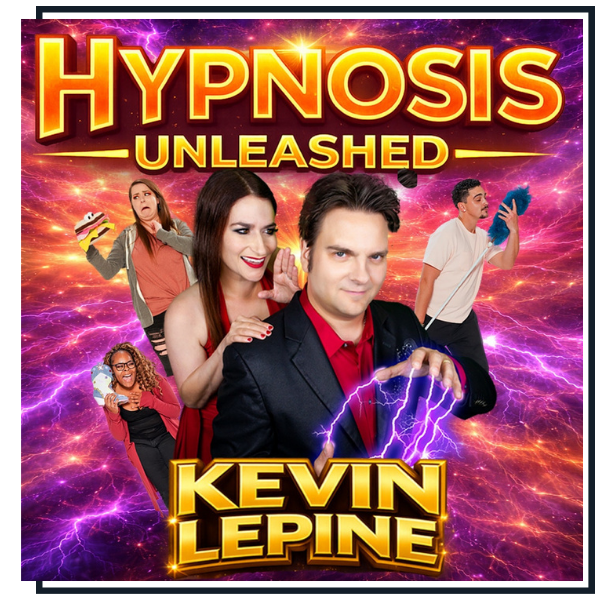
Kevin performs his downtown Vegas show Tuesday to Saturday at the Four Queens Hotel in partnership with his wife, Emily. We meet on video call, his morning and my evening. Amid our prior calendar negotiations, Kevin’s name popped up again via a Grok AI summary of recent hypnosis news. I worked in trade publishing and press/public relations in my 20s and 30s, so Kevin has a proportional, sporting response to hypnotism accolades. But his recent recognition as ‘2026 Stage Hypnotist of the Year’ creates, according to the AI-O-Sphere, a virtuous circle of publicity and a legend that the likes of Houdini could only dream of!
So here’s an insight into the stage hypnotist and magician working his way into the new internet-forged narrative of hypnotism… Meet Kevin Lepine!
Amy: Hello and welcome to Cosmic Pancakes, Kevin! When, how, and why did you first become ‘A Hypnotist’?
Kevin: I wanted to be a lawyer, but my parents made me do this! I didn’t come from money, didn’t come from a show business family. My dad drove trains, mom was a housewife. My parents were so terrified of their kid getting into the entertainment world. I started off doing plays in high school. That got me into an entertainment company where – I mean, you guys are involved in magic, so you’ll understand this progression of, you know, doing costume characters at a kid’s birthday. So, I was ‘Barney’, the purple dinosaur at your little brother’s birthday party! Yeah. And then that got me into clown work because I wanted to make more money. Clowning came with, like… the entertainment company had like a couple of magic tricks, what I would call the generic kids’ party magic kit. But I was 16, I was doing that. By the time I was 17, the magic kinda really took off, and I was living in the Detroit area at the time. I started doing a lot of magic, and a lot of close-up magic. Got into sideshow from that, the fire eating, all of that fun stuff. Then when I was 20, I started working around hypnotists, and they said, “With your personality, you might wanna look into this”. This was ’95.
A: Which hypnotists trained and mentored you, and influenced this life course?
K: I had seen a guy – David Rowe – and a couple of others. I was curious about it, but we’re also talking 1995, so the internet wasn’t a thing. And back then, man, these stage guys didn’t teach you. Seriously! Like, they firmly believed that every hypnotist meant they would lose gigs. So I got enrolled in a course for social workers, and I really didn’t like hypnosis shows, ’cause every show I had seen kind of boiled down to, “I’m a jerk who wants to make you look like an idiot”. Yeah.
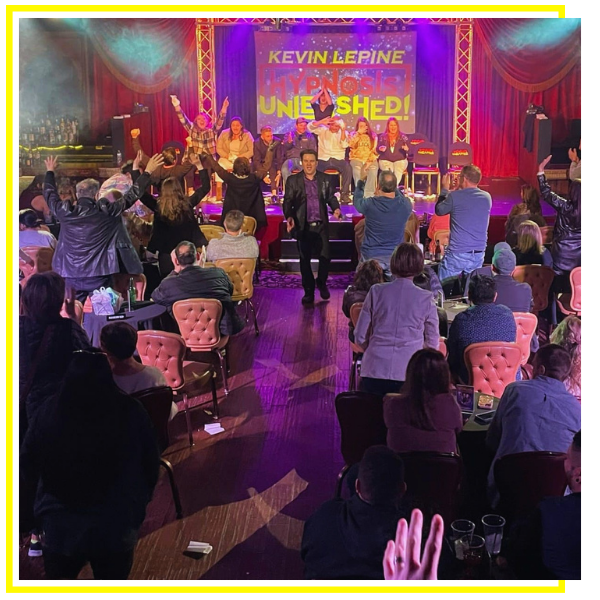
So it’s 2000, I’m living in Detroit, I’ve got the opportunity to move to New Orleans for six months to do my show… and six months turned into five years. While I was down there, I got to work with Harry Anderson; that was amazing. He helped me grow so much. I got to work with a lot of great performers in New Orleans; their first question to me was, “If you could do anything with your show, what do you wanna do?” I said, “Well, I wanna write a show that says I’ve got something fun and interesting to share with you, and if you walk up here on stage, I’m gonna make you look awesome.”
While I was in New Orleans, I also started a touring college production. We’d do the comedy circus sideshow one night, we’d do my hypnosis show another night, and then Hurricane Katrina kicked me out of New Orleans. Went back to Detroit, signed a corporate contract that took me around the world for the next five years. I had the opportunity to move out to Vegas, again, for a six-month deal to do a bunch of corporate gigs, and that was 16 years ago. I’ve been very fortunate. I’m now the longest-running hypnosis show in Las Vegas*.
A: Congratulations on that milestone! A Vegas hypnotist is a distinctive vibe – I’m picturing Woody Harrelson in the Now You See Me film franchise. What do you perceive to be ‘that Vegas vibe’? How does your show and showmanship provide your audience and participants with an iconically ‘Vegas’ hypnotic experience?
K: I mean, you’re in the UK; I don’t know that you’ll ever get bigger than Paul McKenna at a certain point in his career. And I don’t know that you can get bigger than Derren Brown in a lot of ways. And I will say this: I will always, always hate Derren Brown, because he was in Sherlock and I never will be, and I am completely jealous of him. Yeah, he’s in the episode where they were going through how Sherlock would have survived falling off the building; that was one of the explanations, that Derren Brown had hypnotised Watson. I will always be eternally jealous of him, ’cause he got to be in the greatest version of Sherlock ever.
But, the Vegas vibe, I was trying to figure this out for a long time. My wife and I were in Manhattan a year ago, we caught some Broadway plays, and I realised the difference between Broadway and Vegas. Broadway’s allowed to have real emotions. I think this might be true on London’s West End as well, where you can go to a production and you’re allowed to walk out of those performances with an emotion tied to it. In Vegas, you’ve gotta walk out ready to gamble, you gotta walk out being happy, cheery, shiny, happy people.
A: Hypnosis Unleashed, your show, is clearly a high-energy show. Tell us about the show, and your approach to hypnotism and audience participation.
K: I’ve always looked at hypnosis as cooperation. It’s not something I do to you, it’s something we do together. I’m gonna take you on this journey. I’m gonna guide you into that state of hypnosis. I’m gonna make you look great. I’m gonna open up your personality.
The hardest thing with being a hypnotist on stage, it’s not hypnotising people. I often say a brain-damaged monkey can hypnotise people – I know because I do! The hard thing is, once they’re hypnotised, it’s reading their personality and going, okay, what do I think this person’s gonna be really good for? How do I think I can highlight this person? How can I make this person look great? Who’s going to be good and who’s gonna be a little standoffish.
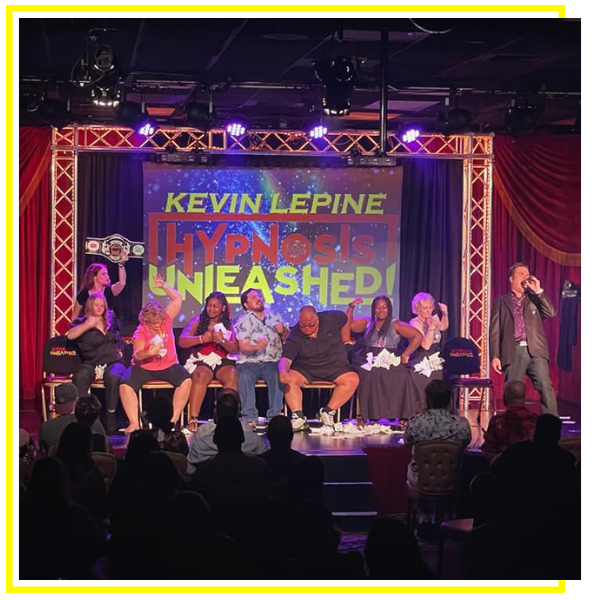
For the Vegas show, I’m fortunate my wife, Emily, and I get to do it together, she’s my onstage partner. I come out first. I’ve never been a fan of the term “pre-talk” ‘cause it doesn't really mean anything, and I've seen too many hypnotists use the term to excuse being boring for 20 minutes. I look at it as an opening monologue – I have to make it engaging and entertaining as well. So it’s about five to 10 minutes of talking about hypnosis, what the show is, what the show isn’t, doing a pendulum experiment with, like, eight or 10 people in the audience, so everybody gets to watch that.
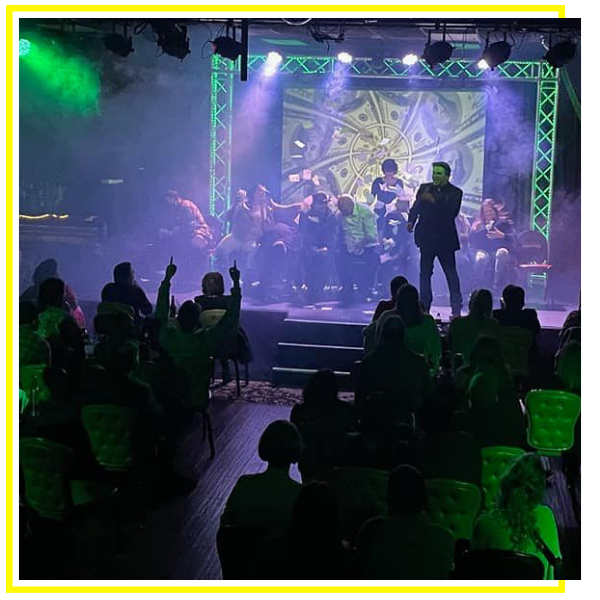
We get the volunteers up on stage – the only people I really don’t want volunteering are the people who wanna prove they can’t be hypnotised and someone who, just, medically, you know you shouldn’t: pregnant, heart problems, broken bones, or on really weird medication that I don’t wanna know about. I tend to use a group induction. Instant inductions take longer. If I’ve got 12 people up there, it’s gonna be way shorter to do a group induction than it is one to one to one. When people are on stage, they’re nervous, they’re uncomfortable, sometimes they’re just really confused. Doing a group style induction, I can do whatever it takes to try and help somebody into that state a little bit deeper.
And, here’s the thing about Vegas, then I get to do whatever I wanna do. If you do high schools, there’s a lot of rules. If you do colleges, there are rules. If you do corporate gigs, there’s rules. When you’re doing comedy clubs in Vegas, there is only one rule: do your audience members wanna pay to come back? That’s the one cool thing about doing what I do is I don't have any shackles on me.
I also end every show with a positive, uplifting message. I think that’s really important. The last thing I do is a three-minute thing that the audience kinda joins in on as well, which is designed to make you feel empowered, it’s designed to make you feel really good walking off stage, and it’s also designed to point out that, if you can do everything you did up here on stage, then you can achieve anything you want to achieve, and you can accomplish anything you put your mind to.
A: Nice. And then they go and gamble?!
K: Yep. And I need somebody to hit a slot machine for a hundred grand right after my show, so that I can say, if you come to my show, you win a hundred grand!
Oh my god, if you like the psychology of hypnosis, check out a casino floor! Seriously, even the carpeting is designed to make sure you can’t focus on something. It is always Saturday afternoon at 4pm in a casino. You’ll never see a clock, you’ll never see a window, you have to walk through a maze to get to the cashier’s area. If you look at it from the point of view of influence and suggestibility, man, that side of things, I find it really fascinating. But there’s a lot more to do in Vegas than gambling. You can have the time of your life here – greatest restaurants, greatest shows, coolest spectacles, great things to see and do. There’s actually a great culture here.
Very few people plan their trip around my show – for the people who do, I am blessed and thankful. The reality is there are the major shows – your Cirque shows, the Sphere, Blue Man Group, Christina Aguilera – then there are cheaper ‘B Category’ shows that you do before or after your big headliner event. People want to see something funny or exciting after dinner.
A: It’s not just Claude AI that has you on its radar, Kevin – Grok cited your ‘2026 Stage Hypnotist of the Year’ win at Vegas’s ‘Performing Hypnosis Summit’ in January in a round-up of hypnosis news. It’s riveting to see a real-time narrative of hypnotism, as harvested from our individual and combined internet footprints, unfold! Your other accolades include the ‘2024 Master of Stage Hypnosis Award’ from the ‘Michigan Hypnosis Conference’ and a 2013 “Kevin Lepine Day” declared by the City of Vegas for 10 December. What does it mean to win an award for hypnotism and which were your best big moments?
K: I appreciate every award I’ve won because I do have a personal connection to them, and it’s great. The first real award I won was in 2008 or 2009 – Real Detroit magazine named me ‘Best Comedy Novelty Act’. And that was just cool because, you know, to get that recognition from your hometown, that’s great.
I took all the awards and I put them on, like, a WWE [wrestling] championship-style belt. That’s the belt I used to take pictures with people after the show. I wanna do something fun and silly with it. The awards are great, but being able to have a career is better. You know, every time I’m out there doing a show, that’s the importance to me. I’m not doing it to win the awards, I’m doing it to win the audience.
A: Tell me more about Emily’s role in the show?
K: Emily does all the hard work in the show. I'm not kidding! I don't like talking to people whose eyes are closed. I don't wanna turn and look at my volunteers who aren’t looking back at me ‘cause their eyes are closed. I wanna address the audience. Because of that, Emily’s in the back making sure the volunteers are comfortable, making sure they’re hearing the suggestions, making sure they’re in trance in the right, comfortable, safe way. She’s doing all of that so that I can get to the: “On the count of three, you will—“. And then it happens. She is so amazing at that.
A: What’s a favourite hypnotic routine you regularly perform?
K: One of my favourites is, so I’ve got a wife on stage, and her husband’s in the audience, and they’ve been married for 20, 30 years. I’ll bring the spouse on stage, and then whenever the spouse says a colour, the hypnotised spouse goes over and gives them the biggest kiss of all time. I love doing it when you have a couple who are seniors. That’s one of my favourite ones because it combines two ideas. One, okay, it’s funny watching grandma and grandpa kissing on stage, but also, don’t you kinda hope that, when you’re at that age, that you’re still holding hands, that you’re still that affectionate? That is the one suggestion that I will leave in for the rest of the night.
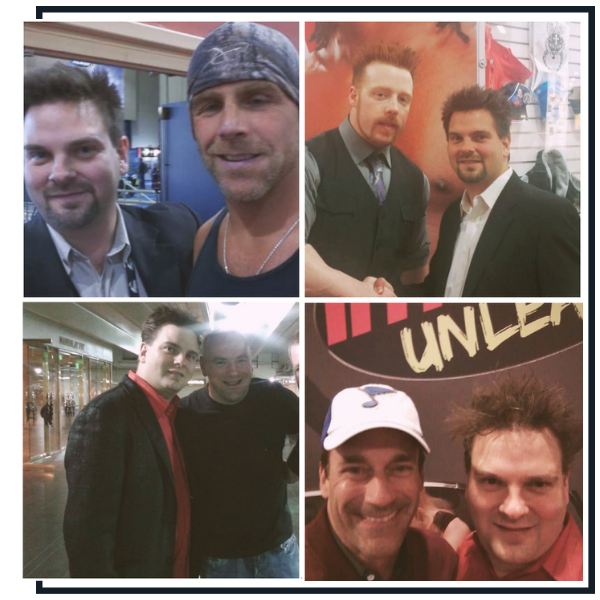
Kevin photographed with famous faces visiting his Vegas show, clockwise from top: WWE wrestling ‘Hall of Famer’ Shawn Michaels; Irish WWE star Sheamus; UFC president and CEO Dana White; and actor Jon Hamm.
A: Stars from sports and the screen have attended your shows. How do famous people impact the show? What are your favourite anecdotes?
K: One of Emily’s favourite moments is we had a professional rugby player on stage, and I'll do a routine where I'm naked in the back and so I tell all the women on stage it’s the ugliest, nastiest butt you’ll ever see in your life, but I tell the guys it’s the cutest, most adorable thing. We had a big rugby player up there, and, as I went to stand in front of him, this dude grabs me, throws me on his lap, and is just rag-dollying me. And Emily, like, it was one of the few times she lost her composure on stage – she’s like, “Let him go, let him go!”. She can't tap this guy hard enough for him to even know she’s there. You’re talking mosquito versus a giant. All I had to do was say “sleep” and he would’ve let me go. But, are you kidding? I'm getting raked out! The audience is laughing their ass off.
My favourite one happened a year ago. Every once in a while you get that moment of, “Oh my god, this couldn’t play any better.” I had a guy on stage, he’s wearing a Frankenstein t-shirt, a horror fan. I told him, “On the count of three, you're gonna open up your eyes, and you are in the hit show The Munsters. You’re a major celebrity, everybody loves you from that show, and you’re here to greet your fans.” So, one, two, three: opens up his eyes, is waving to people, you know: celebrity. “Hey, how’d you enjoy your time on the show?” “Amazing!” “What do you think about your fans?” “Oh, I'm so appreciative of them all!” “Well, okay, but I have your biggest fan in the audience. Would you mind taking a picture with your biggest fan?” “Sure!” I bring this ‘superfan’ up on stage to take a picture. I grabbed his wife’s phone, took the photo, sent the superfan back to his seat, and sent the hypnotised guy back to sleep. Then I looked at the audience and said, “Oh by the way, tonight, playing the part of the superfan, the original ‘Eddie Munster’, Mr Butch Patrick!” So it was a really funny moment, and the guy’s wife just exploded in the audience. Being able to play around with stuff like that is great.
A: And you’ve also incorporated fellow hypnotists into your shows?
K: Yeah, when there’s another hypnotist in the audience, I’ll bring them up on stage. My favourite one, I brought him on stage, and I have no idea what he did, but I know that I put the mic in his hand and I went, “You're doing 12 minutes.” I thought I had food poisoning and, literally while he’s on stage, I ran to the bathroom, puked my guts out. And then I came back on stage and finished the show. Yeah, he did great. He did 12 minutes, I didn't have to worry about it, and I managed to get through the rest of the show. Perfect.
I’ve invited hypnotherapists to come to my show when I'm touring, too, because, hey, there’s gonna be a bunch of people in this room who are interested in hypnosis. I don’t do therapy 40 hours a week, so I don’t wanna do therapy. “Why don’t you come, bring some business cards, I’ll introduce you in the show, and then people can come and talk to you about that.” There’s a great tandem; teamwork between stage and therapy. I know a lot of psychologists and psychiatrists – there are things they don’t wanna do. Like, I've got psychiatrists friends who use hypnotists all the time if somebody wants to quit smoking. My psychiatrist friends are like, “Look, go see the hypnotist. He’s gonna be a little bit better for your budget, that’s what he does. Listen to them, if you have questions, come and talk to me about it after.”
A: But you don’t practice hypnotherapy yourself?
K: I don't do therapy. I think that, once you go to the therapy side, then you’re using multiple ideas at once. But there’s a lot of strength in it, and there is so much people can offer and that we can do. I think that hypnosis is a state of focus. Honestly, it would make so much more sense if I could say, “On the count of three, you will focus. One, two, three: focus!”, instead of, “Sleep!”. The important part is you’re becoming focused on one idea. One thought at a time. That’s a very James Braid ‘monoideism’ perspective. For what I do, I find that to be more of a truth.
If you’re gonna do hypnotherapy, doing hypnotherapy in an office is important. The office is important because people feel it’s important. When people have to drive to your office, when they have to sit in your office, it adds a sense of importance and seriousness to it. That’s one thing that I think people don’t understand about hypnosis – they think the conscious mind is supposed to shut off completely, like you’re supposed to be ‘blacked out’ in hypnosis, and you never are. There’s always a sense of awareness.
A: Turning back to hypnotism as entertainment, what are your favourite popular culture hypnosis references from films and books, etc?
K: Episode IV, A New Hope! “These aren’t the droids you're looking for.” That was probably my first experience with the idea of a hypnotic suggestion. Who didn’t wanna be able to do that? You know, teachers coming around, “Where’s your homework?” “You don’t want my homework.”
Books… One of the first books that I read on hypnosis that made sense was a book on clinical hypnosis. I have all these different books on hypnosis – it’s funny; hypnosis through the years. Sometimes I’ll flip through a book from, like, 1910 and read about how you have to wave magnets over people’s bodies for it to work, just to watch the evolution on the understanding. Because everybody tried to make it mystical. I think the less mystical and the more practical we make it, the more people go, “Oh, I’d love to give that a shot.”
A: On that note, what are your final reflections for any aspiring performance hypnotist wanting to ‘give it a shot’?
K: Harry Anderson said to me, “Don’t try and be the next me; go out there and be the first you.” Granted, there’s always gonna be somebody you emulate in the beginning. But I think one of the advantages I had is I really didn’t meet a lot of hypnotists until after I was deeply in my hypnosis career.
I don't know if this is true in the UK, but I’ve noticed in America, ‘star quality’ is really regional. There’s somebody in an area that people are trying to be like because that one person in that area is so great… I got to work with Terry Stokes for quite a while. He did the Calgary Stampede forever; he did really big hypnosis shows. In the mid-late ‘80s, he was kind of responsible for bringing hypnosis shows back to fairs and festivals, ‘cause they had gotten kind of cliche and thrown out. He did a really good job of bringing those back in. Working with him was really, really educational. And what was funny is, because of him, I discovered that most hypnotists were doing a bad Dean Martin impersonation! ‘Cause Terry didn't wanna be a hypnotist, he wanted to be Dean Martin, but he can’t sing. But he took Dean Martin to heart, and there was a lot of, like, Dean Martin’s presentation. I grew up in punk rock clubs – if everybody else was gonna be Dean Martin, then I’ll be Joey Ramone!
Those who are overly influenced by somebody, you can kind of see shades of that performer over and over in them. Terry is an old Southern guy. Deep, deep Southern. And because of his influence, I have watched guys from New York, with a very sleek New York presentation, do one of Terry's routines, and during the routine, all of a sudden they will have a Southern accent – it’s that bad! So as you grow, there’s an importance to not starting off by doing ‘a Derren Brown theatre show’, because, until you learn how to work a group of 20, 30 people, you don’t really know how to work a group of 150, 200, 250, 500, 1,000. You know, you kinda have to build your skill up a little bit as you’re going through that.
At the end of the day the awards are fun, the history is fascinating, and the AI chatter is entertaining – but the only thing that really matters is that moment when someone walks off stage feeling a little more capable than when they walked on. That’s the whole game. Everything else is just the carpet in the casino!
*Stage hypnotist Marc Savard previously held the reputation for the longest-running Vegas stint, but he ’retired’ to cruise ship performing during the Covid pandemic.