FETCH ME MY PSYCHOSTETHOKYRTOGRAPHMANOMETER!
Powers That Be – Alexander Cannon
We join the author of today’s book, Alexander Cannon – psychiatrist, hypnotist, occultist, magician, and author – in 1935 pre-war Britain. Cannon (1896-1963) is buoyant from the success of his book, The Invisible Influence, 1933, which brought the secret powers of the Orient to Western practitioners, and Powers That Be continues to preach the relative wisdoms and wonders of then-novel belief systems and spiritual practices.
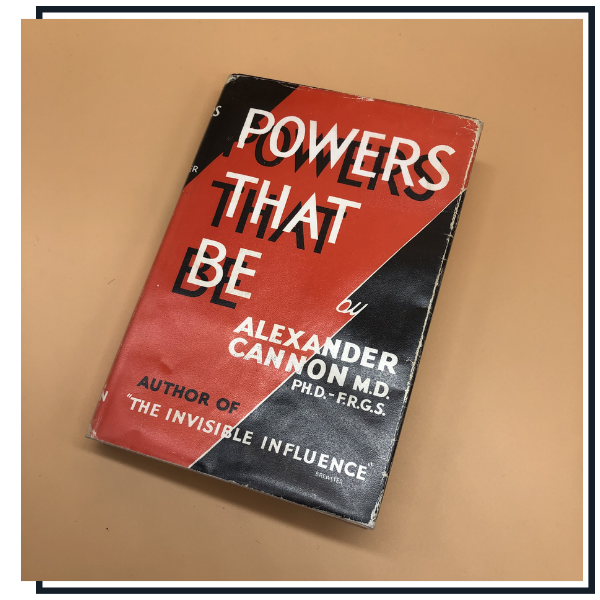
At time of writing, Cannon was not only a credible source of mystical news and innovation, but also a Royal courtier and servant of Colonial British interests in his capacity as ‘overseer’ of British and Asian penal and psychiatric facilities. I’d speculate that he was, as psychiatrist, ‘by Royal Appointment’, based on his recurring role in palace life and, later, scandalously, King Edward VIII’s abdication to marry an American socialite and probable Nazi sympathiser, Wallis Simpson. Cannon strongly shaped perceptions of occult hypnotism during this period, though British security service MI5 branded him a “quack and compulsive liar” after the war.
Cannon is a busy man. Populist leader Adolf Hitler was rising up and the spectre of war was once again upon Europe. The book is a gathering of reflective writings plus reproduced lectures (that wowed Mayfair): there is a earnest stridence to his words – an optimistic power that cannot be faked… A foreknowledge of mesmerism and hypnotism (and magic) prepares us, The Victors of Battle, for the coming bigger truths of God and Man, delivered via Cannon’s firsthand accounts of Eastern Yogis and Indian Fakirs, royals and revolutionaries. We glimpse the life of an adept – of naked yogic training regimes and elaborate magick ceremonies – but are reassured by Cannon’s, and his brethren’s, grip of this unruly, beyond-Empire world.
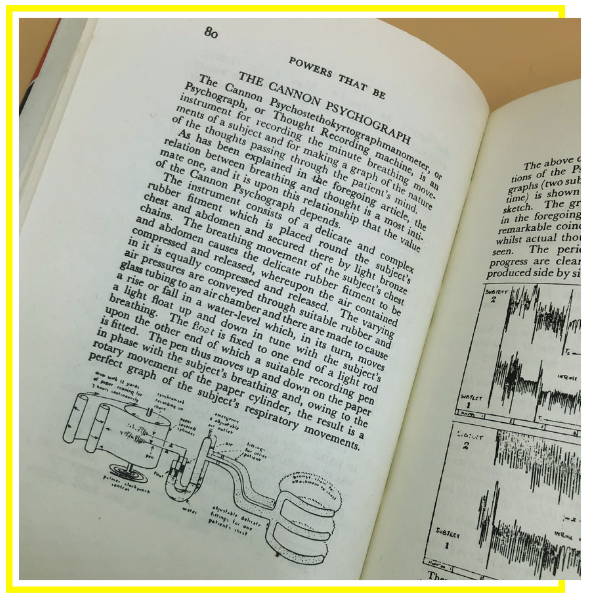
Cannon writes persuasively of hypnotism – he considers telepathy and other psychic phenomena as inextricably related to the field, and pursuing these powers is the thrust of his work. He suggests ‘hypnotism’ be renamed “The Psychic State,” sharing his formula for coloured light-based inductions, mesmeric bodily presses and passes, and the use of his Cannon Psychograph breathing meter. He describes God and Jesus as a father-son magnetic duo, and mulls the mesmeric forces of figures such as Napoleon and Caesar alongside more modern American players like Mary Baker Eddy. His position is diplomatic – once-secretive states of mind and consciousness (which may be misunderstood by newer nations and naive leaders) are already laid bare, and the invisible threads towards mankind’s shared future are followed by a global cadre of magicians.
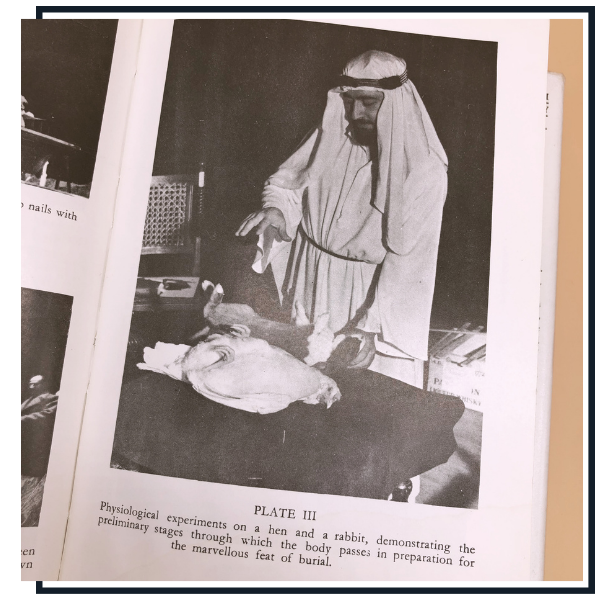
As such, Cannon is confident in sharing the latest and greatest Eastern secrets for his medical and Magic Circle peers and critics: at the book’s centre is a photographic account of a sombre burial stunt, complete with ‘sacrificial’ livestock. While acknowledging that fraud and misinformation are rife in ‘miracles’ such as the Indian Rope Trick, he seems determined to present, say, a unique Fakir or extreme breath-control feat as Science. Squabbling over the procurement of human body parts and/or sufficient ganja-spliff to authentically reproduce the famed ‘boy falls from the sky’ illusion must have become a fixture for the Magic Circle’s Occult Committee. Some magicians sought a snazzy trick for a garden party; Cannon was seeking out “Aryan Hindoos” who, be it by telepathy or the wonders of weed, were in receipt of sensitive gossip before the British government. Bah!
Indeed, the book is every bit as unwieldy as you’d expect of a man later branded a “quack and compulsive liar”. He touts big truths (telepathy is God’s ‘wire’ to man; he sees halos; the world ended in 1936 and we are in Apocalypse; a man can grow a new leg as easily as a crab grows a new claw if he can just fix his mind to it, etc), but there’s a weariness at coming war… A list of names – and socio-professional statuses – of witnesses to his levitation demonstration is rather long for a magician of his station?! It’s as if he senses a futility in seeking to persuade his fellow man against the temptations of Black Magic, “malicious animal magnetism”, and the predictable evils of warmongers. He shares the story of a “Mrs X”, who died a victim of Black Magic, but there’s so little he can comment in direct terms – the latest in, say, hypnotic recordings triggered serious investigation among ‘hypnologists’, and so the book is a subtext to what was unfolding in reality.
Cannon strikes me as a magician stoic in his resolve to use hypnotism as a power, ideally free of the pending war – yet pragmatic about his leadership position as a British psychiatrist within a European, and beyond, professional community. He is particularly unruffled by Death; I imagine he served the decisions of war and, directly and indirectly, consigned humans to death. Perhaps this does imbue a person with certain spiritual insights..? He comments that death by hanging is not true death (as the soul is simply dragged down in the unconscious realm); souls who haunted his youth were overcome by the deployment of ‘modernised’ Eastern wisdom that British colonial rule paid for – with blood.
Blood that Cannon seems determined not be shed again. He especially notes the French-American bromance ‘prophecy’ of revolutionary debts ‘owed’, in spite of British crossed interests, likely to be stoked by German aggression. There is a placatory tone to his writings on America; karma is a universal force for all to share in. Indeed, Cannon is something of a diplomatic figure in hypnotism – his passion for blending lights, colours, sounds, senses is a non-verbal homage to the myriad methods and ceremonies he must have witnessed.
Whether a man who saw humanity mostly through the prism of mass institutionalisation was best placed to win the war via psychic radio-power displays is a moot point. Sane or insane, he must have cut an inspiring, determined figure in 1935, and his book calls on man to come together to pursue a common, higher mission.
“Of course hypnotism is dangerous – in the wrong hands,” comes a standout statement. “So is gunpowder, so is arsenic, so is a bread-knife. Even a baby’s bottle could be ground up and made into a deadly poison. There is nothing good or bad but thinking makes it so, said Shakespeare, and this applies to hypnotism as to everything else.”
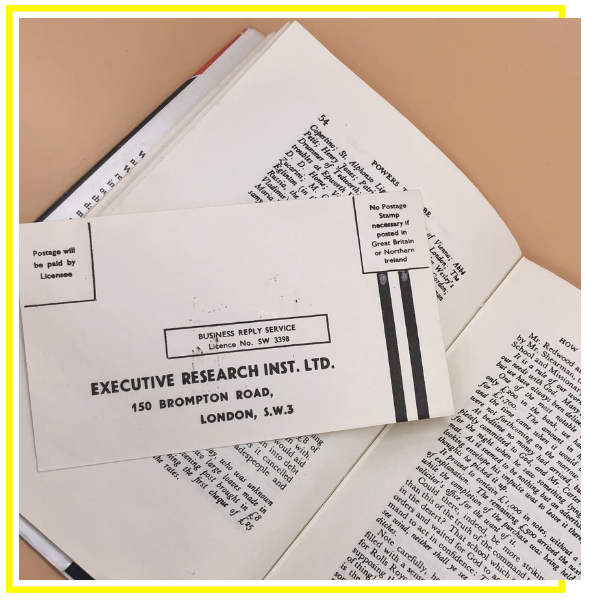
Presumably the reader can send a note in the self-addressed envelope provided with hypnotic contributions to the national war effort.