WORK LIKE ROBOTS
Comment Devenir Médium – Edouard Saby
Welcome to the first official post of 2026 here on Cosmic Pancakes! – our tremendously niche blog delving into the worlds of hypnotism, magic(k), and all things mesmerising.
If you've been following along somewhat so far, you know that I love unearthing forgotten gems that bridge the mystical and psychological as well as the hypnotic. Today, I'm experimenting with blending my (Amy’s!) (in this case spoken word) ‘notes’ with AI transcription via otter.ai – feeding that transcript into Grok to a) remove myself from any ‘psychic’ associations, and b) to see how this technology navigates the ‘music’ [aka editorial ‘signposting’ and/or ‘code-switching’ training *sigh*] of my voice. (Because I am a hypnotist!)
What’s more, Grok has ‘co-written and -edited’ this text post. Kinda. I’m still not convinced we’re fully free of writing and editing… Hence: experimental blend. And I’m not endorsing Grok – I just believed it was better based on me comparing it to ChatGPT for various SEO digi-text tasks. So think of this as me [see/hear/sense where Grok comes in; THIS is the sort of stuff Wilkie Collins was onto!] capturing the “human music” of my ramblings while I (‘I’) skim and translate this 1945 French booklet on psychic mediumship. It's part translation-recitation, part ‘solo-banter’, part dictation-to-typist – a stuttering live reading/commenting on an unfolding piece of history written in a foreign but familiar language. To be clear: I’m not glorifying any of this era’s content; hypnotism and related fields aren't always “magical” in a fun way – they can be “evil”, manipulative, or… just plain dubious.
For further context: my dad died in rural France in 2024, which is still raw. Attending his property in the wake of his death, I found a collection of books on hypnotism, psychology, occultism, and esoterica, many dating to World War II. I believe doctors or intellectuals were the contemporary occupants – perhaps rumoured prostitutes/‘prostitutes’, too. Faced with the property’s uncertain fate – I was warned it might burn down in storms – I couldn't let these magical remnants of our shared recent human past vanish. It feels like a fatalistic loop for the blog: inheriting texts on mesmerism and such right when I'm digging into these topics. Not supernatural fate, just bizarre timing.
Hence I'm translating snippets on my phone via Google Translate as I go, so forgive any clunky phrasing – it’s part of the charm?! I'll mark direct quotes or translated passages in italics to make it clear where the book’s voice takes over. [Grok.] What draws me in is how this ties to hypnotism, mesmerism, and animal magnetism: those historical movements where language and concepts evolved from “animal magnetism” (Mesmer’s fluidic theory of influence) to modern hypnotism. Saby’s work blurs lines between psychic sensitivity, relaxation techniques, and magnetic induction – echoing how mesmerism influenced early psychology and healing practices. People have always been pulled to these fields for varying reasons: some for entertainment, others for therapy; and, in wartime, perhaps for survival and solace.
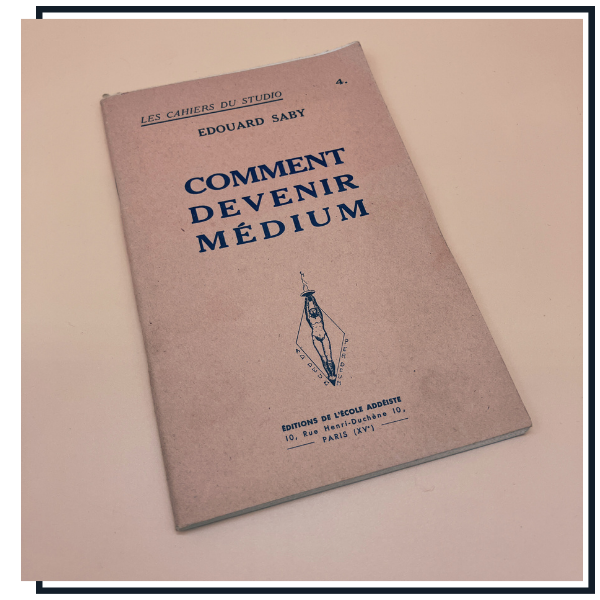
The booklet in question is Comment Devenir Médium (How to Become a Medium) by Edouard Saby, a French occultist born in 1901 who dabbled in esoterica and even critiqued Nazi occultism in books like Le Tyran Nazi et les Forces Occultes (1945 edition). Published in December 1945 as part of the “Les Cahiers du Studio” series by Éditions de l’École Addeiste, it’s essentially a printed lecture Saby gave on November 25, 1945, in the main hall of the Geographical Society in Paris. Post-war Paris, just months after liberation – talk about a time when people were craving healing, spirituality, and a sense of control amid chaos. Saby wasn't some fringe charlatan; he positioned mediumship as natural, tied to the “sixth sense” of the soul, and emphasised critical thinking over exploitation.
The preface sets the stage for the work: We created this collection to satisfy many listeners who wanted to keep the Conferences honoured at our Studio. We have also obeyed the wish expressed by our subscribers outside of Paris, who, deprived of our lectures, will be happy to receive them in printed form. Finally, we intend to publish in this collection studies that are very interesting in their substance, but which cannot be published as books due to their limited length. It’s like an early podcast turned zine – fascinating for a niche like mine, where hypnotism often crosses into public lectures and self-help.
Saby opens strong: The title of this lecture, how to become a medium, was not chosen by chance, and even less by cunning, but because it corresponded very precisely to the presentation I intend to give. For mediumship is not, for me, such an extraordinary phenomenon, the medium of a subject of another kind. All this is much simpler and devoid of all mystery. In fact, nothing is more natural than mediumship, which is the expression of the Sixth Sense, which seems to belong to the soul... Here, he’s demystifying it, much like how mesmerism stripped away superstition to focus on natural forces. No hocus-pocus; it’s about innate human potential, akin to the “magnetic field” in hypnotism where suggestion and relaxation induce states of influence.
He warns against frauds: The medium who claims never to be wrong, but; the fortune-teller, who guarantees “see everything”, are probably not mistaken… about the critical sense of their clientele and clearly see… the exploitation of their credulity. (Google’s translation gets poetic here – “mistake bladders for lanterns” is a French idiom for delusion.) There is also a stark warning against Black Magicians, who are “criminals”, distinguishing sorcerers from such dangerous, flagrant “swindlers” and pushers of “snake oil”. This resonates with mentalism’s evolution from mesmerism: distinguishing genuine influence (like hypnotic suggestion) from scams. Saby stresses sincerity over pride, reminding us that animal magnetism’s roots were in healing, not hoodwinking.
Diving deeper, he explores psychic exercises rooted in the nervous system – breathing, relaxation, and imagination. Primal fear caused by birth, by the first separation from the mother, a moment when it was reasonable to believe that the child has experienced very distressing feelings of tension. This feels psychoanalytic, linking to how hypnotism addresses trauma through relaxation. He ties it to ancient traditions: schools of mediums in Greece, China, Egypt, emphasising development of sensibility, thought, and love – the physical, mental, and psychic.
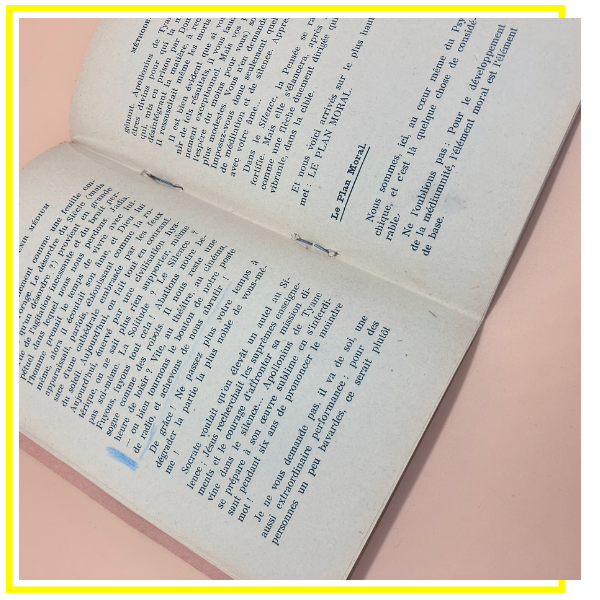
A standout literary passage, highlighted in blue in my copy (a poignant touch amid the yellowed pages): We fret uselessly like a leaf carried about by a storm. The disorder of the Century (but is it just disorder?), is but part of the incessant agitation and perpetual noise in which we lose ourselves in the past. Man took the time to live with himself, and he listened to his soul and God appeared to him, sometimes dazzling, like the rose window of a cathedral ablaze with sunlight. Today, we do everything in a rush, irritated by a hysterical civilisation, we can no longer bear anything, not even ourselves, solitude, silence. Let's flee. Let's flee all that. Let's do our work like robots. This critique of modern frenzy screams relevance to mesmerism’s call for quietude – essential for hypnotic trance. In a post-WWII context, it’s a plea for inner peace amid “perpetual noise”, much like how animal magnetism promised harmony through fluidic balance.
Practical bits echo hypnotic techniques: Everything radiates. Thoughts emit waves that instantly fix themselves between two bodies of the same nature; an induction occurs... a magnetic field that varies in quality according to the nature of these bodies and influences them. Ah! “Induction!” That's straight from mesmerism’s playbook, upstream of hypnotism, where passes and gazes create ‘rapport’. Saby recommends creating a “psychic atmosphere” with colours, symbols, and relaxation exercises, suggesting: a well-ventilated room that often receives sunlight; that the exercise should be about one hour; and stating primary conditions, “after ablutions”, to lie flat on one’s back; and secondary conditions, of dim light or semi-darkness, and silence. Sound familiar? It's the setup for hypnotic sessions, emphasising ventilation, timing (morning/evening best), and avoiding distractions – like noisy neighbours “torturing Chopin”!
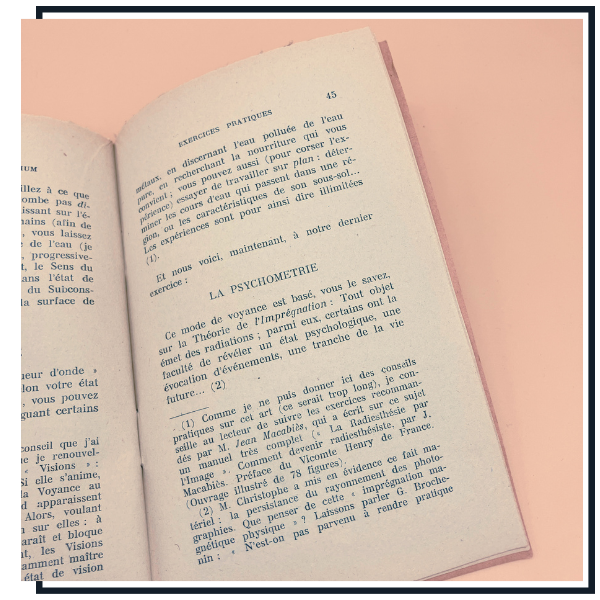
He touches on dreams, astral projections, and psychometry (sensing from objects), which blur into mentalism tricks. Detection of feelings when you receive a letter, open the envelope, plunge your fingers inside and try to determine the quality of its contents. This could be cold reading or genuine sensitivity, but it highlights why people flock to these fields – for connection, healing, or even wartime escapism. Imagine the anxiety or ‘excitement’ (in the true and full sense of the word; it is a word now positively biased and linked to consumerism) of receiving certain types of letters… Mediums could act as ceremonial, perhaps neutral, or, yes, sadly, spiteful ‘bizarre magicians’ for individuals, families, and groups in the aftermath of war.
In conclusion, Saby elevates mediumship. The medium cannot be a sideshow attraction... They must be the representative type of the moral man and the man truth... The mediumship is not a charlatan’s entertainment, but a sacred task whose ultimate goal is to reveal man to himself. Noble, if preacher-y, and it appeals to those drawn to hypnotism's ethical side – using influence for good, not manipulation.
Backpage adverts include Saby’s anti-Nazi occult book – a relief for me in making the decision to bring these books onto British soil. These dark materials were about shared humanity in emergencies, differences aside. But, more than that, they were riddles – raps, perhaps – for displaced peoples, past, present, and future:
To monetise it, or for a simple purpose of curiosity, is to inevitably devote yourself to failure. This study should only be engaged in with extreme fervour and with a single aim of improvement and progress. We often talk of “black magic”, ‘return of affection’, of “luck at the Lottery”, etc… and I no longer complement the excellent people who asked me for… la-lismans “to succeed in business, in the situation or… in love”. I had to to confess to them that if there were “Occultists” capable of establishing such formulas, they would probably not fail to use them, on board, to their advantage.
“You are never so well served as by yourself…”