NOT THE MANCHURIAN APPROACH
You, Too, Can Be A Hypnotist – David J Lustig (La Vellma)
A historian of magic, and member of The Magic Circle’s museum team, sent us this absolute beauty of a pamphlet. The full title, in original case, is You, Too, Can Be A HYPNOTIST – How to stage & present The HYPNOTIC PERFORMANCE for: TELEVISION; RADIO; STAGE; AUDITORIUMS; NIGHT CLUBS; PRIVATE ENTERTAINMENTS (formerly “VAUDEVILLE HYPNOTISM)”, which has to be the longest hypnosis book or pamphlet title we’ve ever seen.
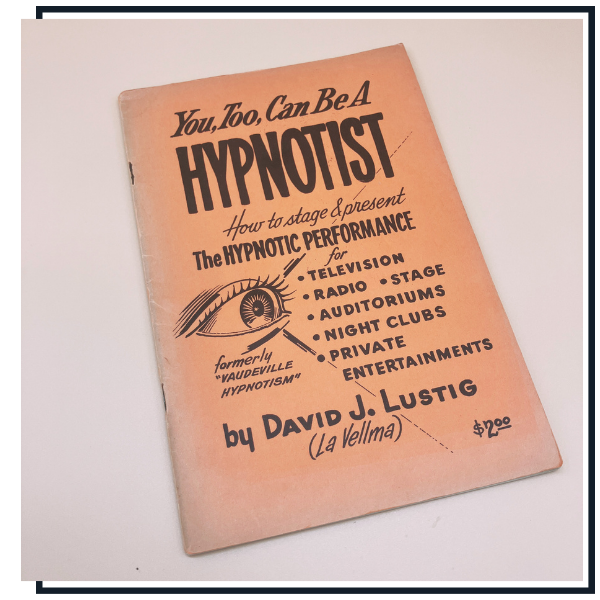
The reason this is such an interesting item is because it contains no hypnosis, whatsoever! And that’s not a snide “they don’t know what they’re talking about” comment; that’s a direct and fair reference to the content matter. The author writes (in the second preface): “Vaudeville Hypnotism is frankly a collection of tests and routines without any pretence nor claim (by the performer) to genuine Hypnotic experiments.”
Ah, I see, you say; it’s non-hypnotic tests and routines! Hypnotic phenomena but without the hypnotic induction or supposed trance! Pure demonstrations of phenomenological control, but from back in 1930! But no, dear reader, you would be sorely mistaken. The author is exceptionally clear, after imploring the reader to study real hypnotism, he states, “the fact still remains he is but an actor playing the part of a Hypnotist.” But how do you do a hypnotism act without any hypnosis? By cheating! By training and bringing a set of stooges to each and every performance and using them for every demonstration. Lustig recommends simply dismissing any real audience members who come up as not being right for the performance during the first selection test.
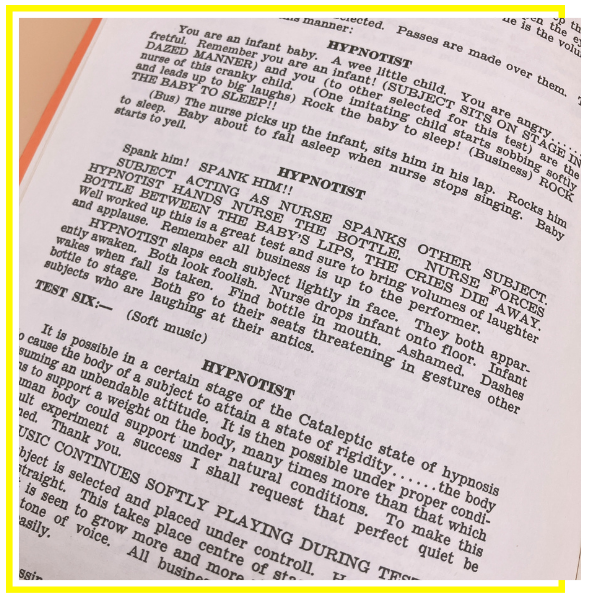
Wait, what? Yep, a pamphlet about performing entirely fake hypnotism acts. I can’t quite fathom the economics of it, as I’m sure 10 or so stooges would all want paying from each performance as well. Given the first stage hypnosis show I saw in-person cost less than a fiver and there were maximum 40 people in that pub in Sheffield, it just doesn’t seem to work. Maybe it was a bad night; maybe the hypnotist made up the difference by selling his range of hypnotherapy CDs; or maybe £200 doesn’t stretch very far if he had to pay stooges. He did his own music cueing and manned his merch stand, but then if he was paying stooges, I guess he’d have to pick up the slack as there wouldn't be any spare money for an assistant or roady. He couldn’t really get the stooges to run the music or sell his merch!
Or could he? Maybe the first routine could be, “You are a sound technician; here is a set list with music cues; when I count to three you’ll open your eyes and be the best sound technician anyone has ever seen… heard. 1 -2-3 open your eyes! Now go get over there and run the sound, Jeff. I mean, Complete Stranger That I’ve Never Met.” The last routine could be,“Nothing brings you greater pleasure than to sell my merchandise for me…”
But no; contrary to the implications of this pamphlet, stage hypnosis usually doesn’t involve stoogery. It doesn’t have to, as, with a large enough audience, there will always be exceptionally gifted participants ready and willing to be part of the show. The routines themselves are well-written and provide the majority of the details needed to perform them. They lack a lot of the jokes that would probably be required, relying instead on the natural comedy of the routines, while the hypnotist stays serious and in control. This might have worked in days gone by, when the spectacle itself would be cause for amusement, but for decades and decades, audiences have demanded far more for their laughs.
In addition to the routines, there are also lots of pieces of advice, not dissimilar to the advice I received from (the late) Jon Chase when he taught me back in 2004. Lots of stage presentation thoughts, a huge encouragement for practice, how to handle various situations, marketing, etc. All great stuff, and much of it still applicable today, and relevant for both magic and hypnosis acts.